
Cloud Categories
Completion requirements
Cloud Categories
Cloud Categories
Cloud Computing technology, which comes out with 4 different types, allows it to be used in different areas and in different ways.
- Public Cloud: It is a cloud
technology established with servers on the Internet. Services that a provider
provides to a large number of customers on the web are called public cloud
services. The SaaS, IaaS, and PaaS examples mentioned above all provide public
cloud-based services. The biggest benefit of using public cloud services is the
ability to share resources at scale, allowing organizations to offer their
employees more talent than would be possible alone. An example of this
pay-as-you-go model that you would use in small and medium-sized companies is
e-mails.

Figure 4: Public Cloud Structure
- Private Cloud: It is a cloud
technology preferred by large companies whose information is important. Private
cloud means the use of cloud computing resources exclusively by a single
business or organization. All information is in the hands of the founder and
access security and privacy is high. The private cloud can be physically
located in the company's own data center. Some companies may work with a
third-party service provider to host their own private clouds. Services and
infrastructure in the private cloud are provided over a private network.

Figure 5: Private Cloud Structure
- Hybrid Cloud: It is a cloud
technology that emerges from the combination of Public and Private Cloud.
Hybrid cloud environments combine and connect the public and private cloud
through a technology that allows data and application sharing between the two.
By allowing data and applications to be moved between private and public cloud,
hybrid cloud offers greater flexibility and deployment options, while helping
to improve existing infrastructure, security and compliance processes. Hybrid
cloud is often used when an organization needs to store sensitive data in a
private cloud, but wants employees to access applications and resources in the
public cloud for daily communication and collaboration.
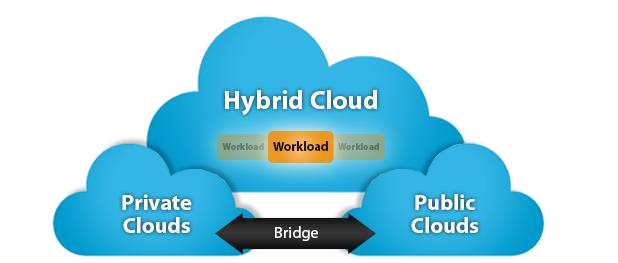
Figure 6: Hybrid Cloud Structure
- Community Cloud: It is a cloud
technology that hosts services that are shared with several companies.
Community members can access applications and data.

Figure 7: All Cloud Categories